
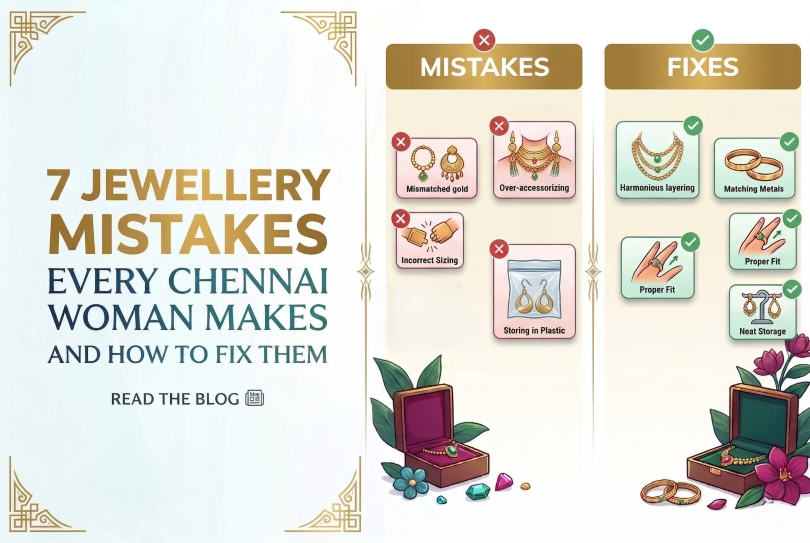
Quick Answer: Most Chennai women unknowingly make common jewellery mistakes — from wearing wrong gold karatage to mismatching traditional pieces with modern outfits. This guide covers the 7 most common jewellery mistakes Chennai women make, why they happen, and exactly how to fix them. Whether you shop at T. Nagar or browse online, these tips will help you wear jewellery smarter, look better, and spend wiser.
Contents
- 1 Introduction: Why Jewellery Matters More in Chennai
- 2 Mistake 1: Buying Gold Without Checking the Hallmark
- 3 Mistake 2: Choosing the Wrong Karatage for the Wrong Purpose
- 4 Mistake 3: Ignoring Skin Tone When Choosing Jewellery Metal
- 5 Mistake 4: Storing Jewellery Incorrectly and Causing Permanent Damage
- 6 Mistake 5: Over-Layering or Under-Accessorising for the Occasion
- 7 Mistake 6: Wearing Jewellery During Activities That Damage It
- 8 Mistake 7: Never Getting Jewellery Professionally Cleaned or Inspected
- 9 Bonus Section: Special Considerations for Chennai’s Climate and Culture
- 10 Summary: The 7 Jewellery Mistakes and Their Fixes at a Glance
- 11 About Plushh Chennai
- 12 Frequently Asked Questions (FAQs)
- 12.1 What is the best gold to buy in Chennai for traditional jewellery?
- 12.2 How do I check if gold is real in Chennai?
- 12.3 How often should I clean my gold jewellery?
- 12.4 Can I wear gold jewellery every day in Chennai?
- 12.5 Why does my gold jewellery look dull even though it is real gold?
- 12.6 What jewellery goes well with a Kanjivaram saree?
- 12.7 Is it safe to buy jewellery online in Chennai?
- 12.8 What is the difference between temple jewellery and regular gold jewellery?
- 12.9 How should I store pearl jewellery in Chennai’s humid climate?
- 12.10 What is making charge in gold jewellery and how can I reduce it?
Introduction: Why Jewellery Matters More in Chennai
Chennai is a city with gold in its DNA.
From the crowded lanes of T. Nagar to the quiet rituals of Karthigai Deepam, jewellery here is never just decoration. It carries emotion, tradition, and identity. A woman in Chennai does not simply wear gold — she carries her family’s legacy on her wrist, her neck, and her ears.
But even in a city that knows jewellery so well, mistakes happen. And they happen more often than most women realise.
Some mistakes are small — like wearing a heavy temple necklace with a salwar kurta. Others are costly — like buying 18K gold thinking it is the best option when 22K is the traditional standard for Indian jewellery. A few mistakes even affect resale value, gemstone life, and daily comfort.
At Plushh Chennai, we have spoken with hundreds of women about their jewellery choices. These are the 7 mistakes we see again and again — and how you can fix each one starting today.
Mistake 1: Buying Gold Without Checking the Hallmark
What Is a Hallmark and Why Does It Matter?
Walk into any jewellery shop in Chennai — from a small store in Mylapore to a big showroom in Anna Nagar — and the salesperson will tell you their gold is “pure.” But pure by whose standard?
A BIS hallmark is India’s official certification for gold purity. It is given by the Bureau of Indian Standards and tells you exactly what you are buying. Yet many Chennai women skip this check entirely.
This is one of the most common — and most expensive — jewellery mistakes a buyer can make.
Without a hallmark, you have no proof of purity. You might pay for 22K gold and receive something far lower. Over a lifetime of buying, this mistake can cost you lakhs of rupees.
What to Look for on a Hallmarked Piece
Since July 2021, India has made BIS hallmarking mandatory for gold jewellery. Every piece should carry a six-digit alphanumeric HUID (Hallmark Unique Identification) code. You can verify this code on the BIS Care app or their official website.
A hallmarked piece will show:
- The BIS logo (a triangle with the letters BIS)
- The gold purity (916 for 22K, 750 for 18K, 958 for 23K)
- The HUID code
- The jeweller’s mark
How to Fix This Mistake
Before you buy any gold jewellery in Chennai, ask to see the BIS hallmark clearly. Use the BIS Care app to scan the HUID and verify the purity in real time. If a seller refuses or says their gold “does not need” a hallmark, walk away.
This single habit can save you thousands of rupees on every purchase.
External reference: BIS Official Hallmarking Information
Mistake 2: Choosing the Wrong Karatage for the Wrong Purpose
The 18K vs 22K Confusion
This is the question we get almost every week: “Which is better — 18K or 22K gold?”
The honest answer is: it depends on what you plan to do with the jewellery.
Most Chennai women buy jewellery for two reasons — daily wear or special occasions. And the right karatage differs for each.
22K gold contains 91.6% pure gold. It is softer, richer in colour, and the traditional standard for Indian jewellery — especially temple jewellery, bridal sets, and heirloom pieces. Most traditional designs look best in 22K because the gold tone is warmer and more authentic.
18K gold contains 75% pure gold. The remaining 25% is a mix of metals like silver, copper, or palladium, which makes it harder and more durable. It is ideal for diamond jewellery and daily wear pieces like rings and bracelets, because the alloy protects the setting and reduces scratching.
14K gold has even less pure gold (58.5%) and is common in Western-style fine jewellery, but it is rarely preferred for traditional Indian designs.
The Mistake Chennai Women Make
Many Chennai women buy 22K gold for diamond jewellery. This is a mistake. Diamonds and precious stones need firm settings. Softer 22K gold bends and wears down faster, which can loosen prongs and cause stones to fall out.
On the other side, some women buy 18K gold for traditional sets, thinking the slightly lower price is a good deal. But when worn against a Kanjivaram silk saree, 18K gold looks visibly paler and less rich compared to 22K. The difference is noticeable.
How to Fix This Mistake
Follow this simple rule:
- Traditional jewellery, bridal sets, temple designs: Choose 22K gold
- Diamond rings, daily wear rings, pendants with stones: Choose 18K gold
- Lightweight everyday chains and studs: Either works, but 18K lasts longer
Ask your jeweller specifically about the karatage before you purchase. Do not assume — confirm.
Mistake 3: Ignoring Skin Tone When Choosing Jewellery Metal
The Skin Tone-Metal Mismatch Problem
Chennai women have a wide range of skin tones — from fair to wheatish to deep brown. And this range matters more than most people realise when it comes to choosing jewellery.
The wrong metal tone against the wrong skin tone can make jewellery look dull, your skin look ashen, or the piece look cheap even if it cost a lot.
This is a mistake that does not cost money to fix — it only costs awareness.
Which Metals Work for Which Skin Tones?
Yellow gold is the most flattering metal for warm and medium-to-dark skin tones, which are very common in Chennai. It creates a warm contrast that makes the skin glow. This is why traditional 22K gold jewellery has always been the standard here — it works beautifully with the natural skin tones of South Indian women.
Rose gold works well for fair to light-medium skin tones. It has a pinkish warmth that complements cooler, lighter complexions. In recent years, rose gold has become popular in Chennai for lightweight everyday jewellery.
White gold and platinum tend to flatter cool-toned and fair skin. On very dark skin, these metals can sometimes look washed out. However, when set with colourful gemstones, the contrast can work well for any skin tone.
Silver is more neutral and works across skin tones, making it a flexible everyday option.
How to Fix This Mistake
Before buying a piece, hold it near your wrist in natural light. Do not judge it under the bright white lights of a jewellery showroom — those lights are designed to make everything look brilliant. Step outside or near a window and see how the metal looks against your actual skin.
If you are shopping online from a store like Plushh Chennai, look for detailed photos on different skin-tone models or read reviews that mention wearability.
Mistake 4: Storing Jewellery Incorrectly and Causing Permanent Damage
How Chennai’s Climate Hurts Your Jewellery
Chennai’s heat and humidity are not just tough on humans — they are tough on jewellery too.
Gold itself does not tarnish, but it can get scratched, dented, and contaminated by other metals. Silver tarnishes faster in humid conditions. Gemstones like pearls, emeralds, and opals are especially sensitive to moisture and heat. Even diamonds can collect oil and grime quickly in Chennai’s climate, reducing their sparkle.
Yet most Chennai women store all their jewellery together in a single box — gold touching silver, diamonds pressing against soft pearls, heavy pieces on top of delicate chains.
This is one of the most common jewellery storage mistakes, and it causes real long-term damage.
Common Storage Mistakes
- Storing all pieces in one compartment without separation
- Keeping jewellery in bathrooms or near windows where humidity is high
- Not cleaning jewellery before storing after wear
- Leaving silver jewellery unwrapped in open air
- Storing pearl jewellery in airtight boxes (pearls need air circulation)
How to Fix This Mistake
Follow these storage practices:
For gold jewellery: Store in soft cloth pouches or a fabric-lined jewellery box with individual compartments. Keep chains laid flat to prevent tangles.
For silver jewellery: Wrap in anti-tarnish cloth or zip-lock bags with an anti-tarnish strip. Silver tarnishes from sulphur in the air, which is more present in humid cities like Chennai.
For pearls: Store in a soft pouch, never in an airtight container. Pearls need slight moisture and air. Keep them away from perfumes and hair sprays.
For diamond jewellery: Store individually in soft pouches or original boxes. Diamonds scratch other gemstones and even gold if stored carelessly together.
General rule: In Chennai’s climate, store jewellery in air-conditioned rooms when possible, and use silica gel packets to absorb excess moisture inside your jewellery box.
External reference: GIA Guide to Jewellery Care and Storage
Mistake 5: Over-Layering or Under-Accessorising for the Occasion
The Chennai Styling Dilemma
Chennai women dress for a wide range of occasions — temple visits, office meetings, weddings, casual outings, and everything in between. Jewellery choices should change with the occasion. But many women either wear too much or too little, and both create the wrong impression.
Over-layering — wearing multiple heavy necklaces, thick bangles, large earrings, and a maang tikka all at once — is a common mistake at semi-formal events. It can make an otherwise elegant outfit look overdone.
Under-accessorising — wearing a beautiful Kanjivaram saree with just small studs and a thin chain — is equally common at weddings and celebrations. It leaves the look incomplete and muted.
The Right Jewellery for Every Occasion
Temple visits: Keep it traditional and simple. A gold chain, small earrings, and a few bangles are ideal. Avoid heavy or elaborate sets that may get tangled or attract attention in a spiritual setting.
Office wear in Chennai: Chennai’s corporate culture is more formal than most cities. A pair of small gold or diamond studs, a simple chain, and a thin bracelet or watch is the sweet spot. Avoid dangling earrings that distract or jingle during meetings.
Weddings and celebrations: This is the time for your best pieces. A statement necklace, matching earrings, bangles, and a payel (anklet) can all work together if the design language stays consistent. Stick to one style — either all traditional or all contemporary — not a mix of both.
Casual outings: Lightweight jewellery works best. Delicate chains, small hoops, and a couple of thin bangles look effortlessly stylish without being overdone.
How to Fix This Mistake
Use the “one statement piece” rule. Choose one piece that stands out — a bold necklace, a pair of jhumkas, or a stack of bangles — and keep everything else minimal. This creates balance and ensures your jewellery enhances your outfit rather than competing with it.
At Plushh Chennai, many of our collections are designed with this balance in mind — statement pieces that do not need much more added to them.
Mistake 6: Wearing Jewellery During Activities That Damage It
The Hidden Wear-and-Tear Problem
Many Chennai women wear their jewellery constantly — during cooking, swimming, working out at the gym, cleaning the house, and even while sleeping. This habit causes more damage than most people expect.
Gold, especially in higher purities like 22K, is a soft metal. Daily physical activities scratch it, bend prongs on rings, and dull the finish over time. Certain chemicals are even worse.
What Damages Jewellery Fastest
Chlorine (in swimming pools): Chlorine reacts with gold alloys and weakens the metal structure over time. Regular exposure can cause gold to crack or break, especially at thin points like chain links. Never wear gold jewellery in a swimming pool.
Household cleaning chemicals: Bleach, dishwashing liquid, and surface cleaners contain chemicals that dull gold finishes and can corrode the metals mixed with gold in 22K and 18K alloys.
Perfume and hairspray: These products contain alcohol and other chemicals that dull the surface of gold, tarnish silver, and can degrade the nacre (outer layer) of pearls over time. Always apply perfume before putting on jewellery — never after.
Cooking: The heat and steam from cooking are not major concerns for gold, but oils and masala stains can coat gemstones and reduce their sparkle. Salt water from perspiration while cooking can also cause mild tarnish on silver.
Exercise: Physical activity bends rings, snaps thin chains, and can cause stones to loosen. Remove rings and bracelets before going to the gym.
Sleeping in jewellery: Necklaces and chains tangle and break. Earrings can press into the skin and cause pressure sores. Rings can scratch your face or your partner during sleep.
How to Fix This Mistake
Make it a habit to remove your jewellery before:
- Swimming or any water activity
- Cooking with oils, spices, or heat
- Applying any beauty or personal care product
- Working out or playing sports
- Sleeping
Keep a small dish or tray near your bathroom and kitchen where you can place your jewellery safely during these activities. This one habit alone extends the life of your pieces significantly.
Mistake 7: Never Getting Jewellery Professionally Cleaned or Inspected
The “It Looks Fine” Trap
Here is something most jewellery shops will not tell you: your gold needs maintenance.
Many Chennai women buy a piece, wear it for years, and never take it back for professional inspection or cleaning. The jewellery may still look “fine” on the surface, but underneath, something could be going wrong — a prong loosening, a tiny crack forming, an inclusion in a gemstone expanding.
Regular professional cleaning also makes a dramatic difference in how jewellery looks. Gold that seems dull and old often looks brand new after a professional clean and polish.
Signs Your Jewellery Needs Professional Attention
- A diamond or gemstone looks loose or wobbles slightly when touched
- The surface of your gold looks dull, scratched, or discoloured
- A clasp on a necklace or bracelet feels weak or stiff
- Prongs on a ring look uneven, bent, or worn down
- Silver pieces have turned black or greenish
- A pearl necklace shows gaps in the silk thread at the knotting
How Often Should You Get Jewellery Inspected?
For frequently worn pieces — especially rings and bracelets — once a year is ideal. For occasional-wear pieces, once every two to three years is sufficient.
Most reputed jewellers in Chennai offer free or low-cost cleaning services. Use them. The cost of a professional clean is nothing compared to the cost of losing a stone or breaking a chain that could have been caught early.
How to Clean Gold Jewellery at Home (Between Professional Visits)
You can safely clean gold jewellery at home using warm water, a few drops of mild dish soap, and a soft toothbrush. Soak the piece for five minutes, gently scrub, rinse with clean water, and pat dry with a soft cloth.
Do not use toothpaste — it is abrasive and scratches gold. Do not use ultrasonic cleaners at home without checking with your jeweller first — they can loosen certain stone settings.
For silver, a soft silver polishing cloth works well for light tarnish. For heavy tarnish, a paste of baking soda and water applied gently with a soft toothbrush can restore the shine.
External reference: American Gem Society Jewellery Care Guide
Bonus Section: Special Considerations for Chennai’s Climate and Culture
Chennai’s climate, culture, and traditions create a unique jewellery context that women in other cities may not face. A few bonus points worth knowing:
Sweat and gold: Chennai summers are intense. Heavy sweating can leave salt deposits on jewellery, which dulls the surface over time. Wipe your jewellery with a soft cloth after wearing on hot days before storing.
Temple jewellery: This genre of jewellery — featuring motifs of gods, goddesses, and traditional symbols — is specific to South India and Chennai has some of the finest temple jewellery makers in the country. If you own temple jewellery, know that these pieces are usually made in 22K gold with Kemp stones (treated rubies and red glass). They need gentle care and should not be worn in water or stored in heat.
Bridal jewellery planning: Chennai brides often receive jewellery from both sides of the family. Before the wedding, get an inventory done. Photograph every piece, note its weight and hallmark details, and store everything separately. This prevents confusion, damage, and the occasional family dispute later.
Investing in jewellery vs. buying for beauty: Many Chennai families treat gold as an investment. If that is your goal, prioritise coins and bars over heavily crafted jewellery, since crafted pieces carry making charges that reduce resale value. For beauty and tradition, jewellery designs are worth the premium. Understand which goal you are buying for before spending.
Summary: The 7 Jewellery Mistakes and Their Fixes at a Glance
| # | Mistake | Fix |
|---|---|---|
| 1 | Buying gold without checking the hallmark | Always verify BIS hallmark and HUID code |
| 2 | Choosing wrong karatage for the wrong purpose | 22K for traditional; 18K for diamond and daily wear |
| 3 | Ignoring skin tone when choosing metal | Yellow gold for warm tones; white gold/platinum for cool tones |
| 4 | Storing jewellery incorrectly | Separate storage, anti-tarnish wraps, control humidity |
| 5 | Over or under-accessorising for the occasion | Use the “one statement piece” rule |
| 6 | Wearing jewellery during damaging activities | Remove before swimming, cooking, working out, sleeping |
| 7 | Never getting professional cleaning or inspection | Annual inspection for worn pieces; clean at home gently |
About Plushh Chennai
Plushh Chennai is your trusted destination for handcrafted, quality jewellery designed for the modern Chennai woman. Our collections blend traditional South Indian aesthetics with contemporary design — perfect for every occasion from temple visits to corporate events to grand weddings.
We believe every woman deserves jewellery that lasts, looks beautiful, and carries meaning. That is why we focus on quality, transparency, and helping customers make smarter choices — not just bigger purchases.
Explore our collections at plushhchennai.com
Frequently Asked Questions (FAQs)
What is the best gold to buy in Chennai for traditional jewellery?
For traditional jewellery in Chennai — including temple jewellery, bridal sets, and heirloom pieces — 22K (916 hallmark) gold is the best choice. It has 91.6% pure gold, a rich warm yellow tone, and is the traditional standard for Indian jewellery designs. Avoid buying 18K gold for traditional sets, as the colour will look visibly paler against a Kanjivaram silk saree or traditional outfit.
How do I check if gold is real in Chennai?
The safest and most reliable way to check gold purity in Chennai is to look for a BIS hallmark on the piece. Since July 2021, BIS hallmarking is mandatory in India. Every piece should have a six-digit HUID (Hallmark Unique ID) that you can verify using the BIS Care app, available on Google Play and the App Store. You can also ask your jeweller for a purity test certificate.
How often should I clean my gold jewellery?
For frequently worn gold jewellery, a gentle home cleaning once a month is enough. Use warm water, a drop of mild dish soap, and a soft toothbrush. For professional cleaning and inspection, visit your jeweller once a year. Pieces worn occasionally need professional attention every two to three years.
Can I wear gold jewellery every day in Chennai?
Yes, but choose the right type. 22K gold is softer and more prone to scratching with daily physical wear. For everyday jewellery — rings, bracelets, or daily chains — 18K gold is more durable due to its harder alloy composition. Whichever you choose, remove it during activities like swimming, cooking, working out, or sleeping to keep it in good condition.
Why does my gold jewellery look dull even though it is real gold?
Dullness in gold jewellery is usually caused by a buildup of oils, sweat, lotion, soap residue, and dust over time. Real gold does not tarnish, but these surface deposits reduce its shine. A gentle home clean with warm soapy water and a soft toothbrush usually restores the shine immediately. For deeper dullness caused by fine scratches, a professional polish from your jeweller will bring back the original lustre.
What jewellery goes well with a Kanjivaram saree?
A Kanjivaram saree calls for 22K yellow gold jewellery in traditional designs. Temple jewellery sets, heavy jhumkas, layered necklaces, thick bangles, and a maang tikka all work beautifully. The rich colour of 22K gold complements the silk’s sheen. Avoid white gold, platinum, or silver with Kanjivaram sarees in traditional settings — the colour contrast breaks the cohesive traditional look.
Is it safe to buy jewellery online in Chennai?
Yes, if you buy from reputable platforms or brands that clearly display hallmark details, product weight, making charges, and return policies. Always check if the seller offers a BIS hallmark certificate and whether the piece can be returned or exchanged. At Plushh Chennai, every piece is detailed with its specifications so you know exactly what you are buying before the order is placed.
What is the difference between temple jewellery and regular gold jewellery?
Temple jewellery is a traditional South Indian style that features motifs of deities, peacocks, lotus flowers, and other classical South Indian symbols. It is usually made in 22K gold and set with Kemp stones (red stones made from glass or treated rubies). Regular gold jewellery includes a wider range of designs — contemporary, Indo-western, minimalist, and more — with or without gemstones. Temple jewellery is best for traditional festivals, Bharatanatyam performances, and South Indian weddings.
How should I store pearl jewellery in Chennai’s humid climate?
Pearls need careful storage in Chennai’s humid weather. Store them in a soft cloth pouch — never in an airtight container, because pearls are organic and need minimal air circulation to stay healthy. Keep them away from perfume, hair spray, and direct sunlight. Wipe pearls gently with a soft damp cloth after wearing to remove oils and sweat. Have the silk thread on pearl necklaces replaced by a jeweller every few years, as moisture weakens the thread over time.
What is making charge in gold jewellery and how can I reduce it?
Making charge is the fee a jeweller charges for the labour and craftsmanship involved in creating a jewellery piece. It is charged either as a percentage of the gold value or as a fixed rate per gram. Highly intricate designs like temple jewellery or bridal sets carry higher making charges. To reduce costs, opt for simpler designs if your goal is investment, buy during sale seasons, or compare making charges across multiple jewellers before purchasing. Note that making charges are usually non-recoverable during resale — you get paid only for the gold weight at the current rate.
This article was written by the jewellery experts at Plushh Chennai to help Chennai women make better, smarter jewellery choices. All information is based on industry standards, BIS guidelines, and expert jewellery care advice.
For more jewellery tips, style guides, and curated collections, visit plushhchennai.com.