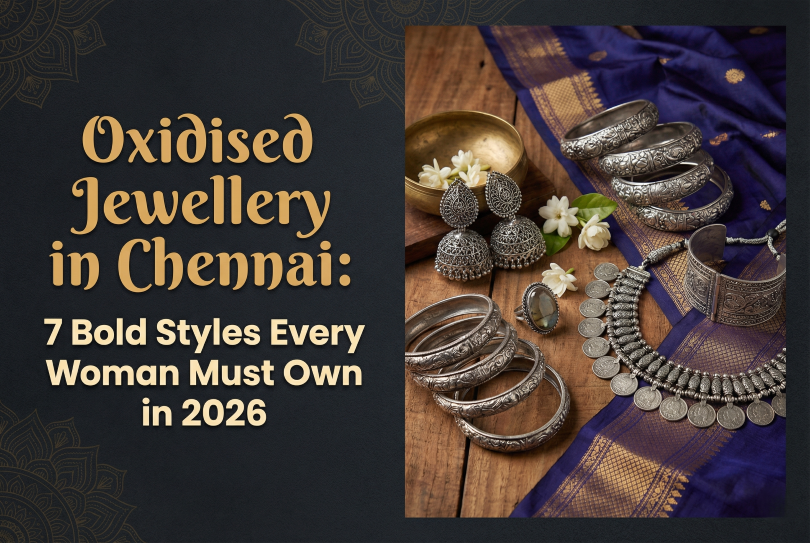
| Quick Answer: Oxidised jewellery is silver-toned, antique-finish jewellery made by treating metal with chemicals or heat to create a dark, aged look. In Chennai, the most popular oxidised jewellery styles in 2026 include oxidised jhumkas, temple-inspired necklaces, Boho rings, tribal bracelets, layered anklets, chokers, and statement maang tikkas. These pieces go well with sarees, kurtis, and fusion outfits. They are affordable, skin-friendly, and trending across South India. |
Contents
- 1 Why Oxidised Jewellery Is Having Its Biggest Moment in 2026
- 2 What Is Oxidised Jewellery? (And Why It Looks So Good)
- 3 The History of Oxidised Jewellery in South India
- 4 7 Bold Oxidised Jewellery Styles Every Chennai Woman Must Own in 2026
- 4.1 Style 1: Oxidised Jhumkas — The Undisputed Queen of Ethnic Earrings
- 4.2 Style 2: Oxidised Temple Necklace — Traditional Power in Every Link
- 4.3 Style 3: Oxidised Tribal Bangles and Cuff Bracelets — Bold on the Wrist
- 4.4 Style 4: Oxidised Choker Necklace — The Outfit Transformer
- 4.5 Style 5: Oxidised Maang Tikka — Forehead Drama for Every Occasion
- 4.6 Style 6: Oxidised Anklets (Payal) — The Most Underrated Style
- 4.7 Style 7: Oxidised Rings — Everyday Wearable Art
- 5 How to Style Oxidised Jewellery With Different Outfits
- 6 How to Care for Oxidised Jewellery
- 7 Where to Buy Oxidised Jewellery in Chennai
- 8 Oxidised Jewellery vs Gold Jewellery: Which Should You Buy?
- 9 Oxidised Jewellery Trends to Watch in 2026
- 10 Learning More: Trusted Resources on Indian Jewellery
- 11 Summary: What You Need to Know
- 12 Frequently Asked Questions About Oxidised Jewellery
- 12.1 What is oxidised jewellery made of?
- 12.2 Is oxidised jewellery good for daily wear?
- 12.3 Does oxidised jewellery fade or turn green?
- 12.4 How do I clean oxidised jewellery at home?
- 12.5 What is the difference between oxidised silver and sterling silver?
- 12.6 Can I wear oxidised jewellery with a saree?
- 12.7 Is oxidised jewellery the same as antique jewellery?
- 12.8 Which skin tone suits oxidised jewellery best?
- 12.9 How long does oxidised jewellery last?
- 12.10 Where can I buy oxidised jewellery in Chennai?
Why Oxidised Jewellery Is Having Its Biggest Moment in 2026
Walk into any jewellery shop in Chennai today. You will find one style that almost every woman is picking up — oxidised jewellery.
It is not new. Women in Tamil Nadu, Andhra Pradesh, and Karnataka have worn dark-toned silver jewellery for generations. But 2026 is different. Oxidised jewellery has crossed the line from traditional to trendy. It is now worn at college fests, office parties, weddings, and casual Sunday brunches.
What changed? A few things came together at once. Social media started celebrating ethnic jewellery. Fast fashion made gold-look jewellery feel tired. And women started wanting pieces that told a story — pieces that looked real, handcrafted, and rooted in culture.
Oxidised jewellery checks all those boxes.
This guide covers the 7 boldest oxidised jewellery styles every Chennai woman should own in 2026. It also explains what oxidised jewellery actually is, how to care for it, and where to buy the best pieces in Chennai.
What Is Oxidised Jewellery? (And Why It Looks So Good)
Oxidised jewellery is metal jewellery that has been treated to give it a dark, aged, antique appearance. The process is called oxidation.
Most oxidised jewellery is made from silver or silver-toned alloys. The metal is exposed to chemicals like potassium sulphide, heat, or acidic compounds. This creates a controlled tarnish on the surface — a deep grey or near-black finish with bright silver highlights peeking through the raised areas.
The result is a piece that looks hand-carved, centuries old, and deeply textured. It has personality. It does not look like it came off a factory conveyor belt.
What Makes Oxidised Jewellery Different From Regular Silver Jewellery?
Regular silver jewellery is polished and shiny. It reflects light evenly. It looks fresh and modern.
Oxidised jewellery has a matte, dark surface. Light catches the raised patterns and leaves the recessed areas shadowed. This creates depth — something a polished surface cannot give you.
Think of it like a carved wooden door vs a plain painted wall. Both are wood. But one tells a story.
Is Oxidised Jewellery the Same as Antique Jewellery?
They are similar but not the same. Antique jewellery refers to genuine old pieces, often 50 to 100 years old. Oxidised jewellery replicates that old look using modern techniques.
Many people use the terms interchangeably in everyday speech, especially in Chennai. When a vendor says ‘antique finish,’ they almost always mean oxidised jewellery.
Is Oxidised Jewellery Safe to Wear?
Yes, when made from good-quality materials. Look for pieces made from 92.5 sterling silver, brass with silver plating, or German silver alloys. These metals are skin-friendly and durable.
Avoid extremely cheap pieces with no labelling. They may contain nickel or lead, which can irritate sensitive skin.
The History of Oxidised Jewellery in South India
Oxidised jewellery is not a recent Western trend. It has been a part of South Indian culture for hundreds of years.
Tribal communities in Tamil Nadu, Andhra Pradesh, Odisha, and Rajasthan have worn dark silver jewellery as a symbol of identity, status, and spirituality. The chunky, dark-toned necklaces you see today in fashion shops are directly inspired by these tribal traditions.
Temple jewellery in Tamil Nadu also uses oxidised finishes. The dark background makes the embossed temple figures — gods, flowers, and vines — stand out with dramatic clarity.
In Chennai specifically, oxidised jewellery has always had a strong presence in Mylapore, T. Nagar, and Pondy Bazaar. But what has changed in 2026 is the audience. It is no longer only older women buying these pieces for religious occasions. Young women in their 20s and 30s are buying oxidised jewellery as their primary everyday jewellery.
7 Bold Oxidised Jewellery Styles Every Chennai Woman Must Own in 2026
Here are the 7 styles that are trending hardest in Chennai right now. Each one works for a different occasion and outfit type.
Style 1: Oxidised Jhumkas — The Undisputed Queen of Ethnic Earrings
Ask any woman in Chennai what one oxidised jewellery piece she would never give up, and almost every answer will be jhumkas.
Jhumkas are bell-shaped dangling earrings. The oxidised version has a dark silver base with intricate carvings — peacocks, lotuses, vines, or geometric patterns. They catch light at the edges while the body stays richly dark.
What makes oxidised jhumkas special is their versatility. Wear them with a cotton kurti on a regular workday. Wear the same pair with a Kanchipuram silk saree at a wedding. They work both ways.
Best outfit pairings for oxidised jhumkas:
- Cotton or linen kurtis in earthy tones
- Silk sarees in jewel colours — deep green, maroon, navy
- Indo-western dresses and midi skirts
- Casual jeans and ethnic tops
In 2026, the most popular jhumka styles are extra-large drops with a chandelier silhouette and smaller studs with a tiny jhumka hanging below — sometimes called ‘studs with drops.’ Both styles are available at Plushh Chennai.
See our trending earring styles: Trending Earrings in Chennai: 7 Stunning Styles Right Now
Style 2: Oxidised Temple Necklace — Traditional Power in Every Link
The temple necklace is one of South India’s most iconic jewellery forms. In its oxidised avatar, it becomes something modern women can wear without needing a full bridal look.
Traditional temple necklaces feature images of deities, mythological symbols, and floral patterns. The oxidised finish makes these carvings stand out beautifully. The dark background creates a contrast that makes every detail pop.
In 2026, oxidised temple necklaces are being worn in two very different ways. The first is the traditional way — layered over a Kanjeevaram saree with matching jhumkas for weddings and festivals. The second is the fusion way — worn over a white linen dress or a plain cotton tee for a bold ethnic-contemporary look.
Key features to look for:
- Coin pendants with embossed deity or floral motifs
- Multi-strand structure for a layered effect
- Adjustable length for versatile styling
- Matching earrings sold as a set
This style works especially well during Navratri, Diwali, and Tamil festivals. It is also a strong choice for a Tamil wedding guest outfit.
Style 3: Oxidised Tribal Bangles and Cuff Bracelets — Bold on the Wrist
Tribal-inspired oxidised bangles are having a massive moment in Chennai in 2026.
These are chunky, wide-cuffed bracelets or sets of thin stackable bangles with a dark oxidised finish. They are inspired by the jewellery traditions of tribes from Tamil Nadu, Odisha, and the Northeast.
What makes them appealing is their statement quality. You do not need to wear much else. A plain white cotton kurti with a pair of oxidised tribal cuff bangles is a complete look.
How to style tribal oxidised bangles:
- Stack three to five thin oxidised bangles on one wrist for a layered effect
- Wear a single wide cuff as the only wrist accessory for a minimalist ethnic look
- Mix oxidised bangles with wooden beaded bangles for a Boho feel
- Pair with plain outfits — the bangles are the hero
Avoid over-accessorising when you wear chunky tribal bangles. Let the wrists do the talking.
Style 4: Oxidised Choker Necklace — The Outfit Transformer
The choker sits close to the throat. In oxidised silver, it becomes one of the most powerful accessory choices a woman can make.
Oxidised chokers in 2026 come in two main styles. The first is a flat, wide choker with a carved panel — very popular with deep-neck blouses and off-shoulder tops. The second is a link-chain choker with oxidised pendants at intervals — more delicate, very wearable with both Indian and Western outfits.
The choker is also the most Instagram-friendly oxidised jewellery piece. It sits in the frame at the right height and photographs dramatically against both light and dark skin tones.
Choker styling guide:
- Pair a wide oxidised choker with a boat-neck blouse and plain saree
- Layer a thin oxidised choker under a longer pendant necklace for dimension
- Wear a single oxidised choker with a white shirt or tee for daily casual use
- Choose a shorter choker for high necklines and a wider one for plunging necklines
Learn how to match jewellery with your outfit and skin tone: 5 Steps to Choose Fashion Jewellery That Perfectly Matches Your Skin Tone
Style 5: Oxidised Maang Tikka — Forehead Drama for Every Occasion
The maang tikka sits in the parting of the hair and hangs over the forehead. In its oxidised form, it is one of the most dramatic and beautiful pieces in South Indian jewellery.
What is trending in 2026 is not the heavy, oversized maang tikka of bridal sets. It is the slim, delicate oxidised tikka — a small pendant on a thin chain, just enough to frame the face without overpowering the look.
This style of tikka is perfect for working women who want to add something special to an ethnic look without committing to a heavy bridal style.
When to wear an oxidised maang tikka:
- Festive occasions — Navratri, Pongal, Diwali family gatherings
- Wedding guest appearances
- Photoshoots and events where ethnic glam is the goal
- Saree day at the office
Pair with oxidised jhumkas for a complete matching look. Or mix with gold-toned earrings for a contrast style that is very popular right now.
Style 6: Oxidised Anklets (Payal) — The Most Underrated Style
Anklets are one of the oldest forms of jewellery in South India. In Tamil culture, wearing payal is both tradition and fashion. In 2026, the oxidised anklet is finally getting the attention it deserves.
Unlike gold or silver polished anklets, the oxidised version makes no sound (no bells) and has a muted, earthy tone. This makes it work-appropriate. Many Chennai women wear layered oxidised anklets to their offices on days they wear ethnic outfits.
The most popular oxidised anklet style in 2026 is a double-layer design — two thin chains at slightly different lengths, one with small carved motifs and one plain. It gives a layered look with just one piece.
Styling tips for oxidised anklets:
- Wear with churidars and salwar sets to show off the ankle
- Pair with open-toe heels or flat kolhapuri chappals
- Stack two or three thin anklets on one leg for a tribal look
- Wear a single anklet for daily casual and double for festive occasions
Style 7: Oxidised Rings — Everyday Wearable Art
Rings are often the most personal jewellery choice. Oxidised rings in 2026 are a category of their own — bold, sculptural, and deeply textured.
The most popular oxidised ring styles in Chennai right now are the wide band ring with carved motifs, the midi ring worn on the second joint of the finger, and the toe ring — still very much a South Indian tradition.
What makes oxidised rings different from regular fashion rings is the texture. They look hand-carved and artisanal. Even a simple band in oxidised silver looks like it came from a craftsman’s workshop in Rajasthan or Tamil Nadu.
Oxidised ring styling ideas:
- Stack three thin oxidised bands on one finger for a modern look
- Wear a single wide statement ring on the index or middle finger
- Mix an oxidised ring with a plain silver ring on adjacent fingers
- Pair oxidised toe rings with anklets for a fully styled foot look
How to Style Oxidised Jewellery With Different Outfits
Oxidised jewellery is uniquely flexible. It moves between traditional and contemporary outfits with ease. Here is a simple guide.
Oxidised Jewellery With Sarees
Sarees and oxidised jewellery were made for each other. The dark tones of oxidised silver complement the rich, vivid colours of Kanchipuram silks, cotton sarees, and Chanderi drapes.
For a wedding look: Choose an oxidised temple necklace, large jhumkas, and a maang tikka. This gives you a traditional, polished appearance without the heaviness of gold.
For a daily saree look: A single oxidised jhumka and a thin oxidised bangle is enough. Keep it simple.
Oxidised Jewellery With Kurtis
Kurtis and oxidised jewellery are perhaps the most popular combination in Chennai right now. Long kurtis with Anarkali silhouettes pair beautifully with statement oxidised necklaces. Short, straight kurtis work best with jhumkas and a stacked bangle look.
Earthier kurti colours — mustard, terracotta, olive, burnt orange — work especially well with the dark tones of oxidised jewellery.
Oxidised Jewellery With Western Outfits
This is the combination that has grown the most in 2026. Chennai women are wearing oxidised jewellery with denim, linen co-ords, white shirts, and midi dresses.
The key is restraint. With Western outfits, choose one strong oxidised piece. A bold choker. A stack of bangles. One dramatic ring. Do not layer multiple heavy pieces.
Also read: 7 Jewellery Mistakes Every Chennai Woman Makes and How to Fix Them
Oxidised Jewellery With Skin Tone
This is where many women go wrong. Oxidised jewellery suits all skin tones, but the way you style it should be different.
For deeper skin tones: Bold, chunky oxidised pieces look striking. High contrast between your skin and the dark metal creates a powerful visual. Go for statement chokers, large jhumkas, and wide cuffs.
For medium skin tones: You have the most flexibility. Both delicate and chunky oxidised pieces work. Try a layered necklace look.
For lighter skin tones: Thinner, more delicate oxidised pieces work better. Avoid extremely dark, matte pieces that can look heavy. Look for pieces with brighter silver accents at the edges.
Full guide: 5 Steps to Choose Fashion Jewellery That Perfectly Matches Your Skin Tone
How to Care for Oxidised Jewellery
One of the biggest concerns women have about oxidised jewellery is whether the finish will last. The good news is that with simple care, oxidised jewellery holds its finish for a long time.
What to Do
- Store oxidised jewellery in a cool, dry place away from moisture
- Keep each piece in a separate zip-lock pouch or soft cloth bag
- Wipe pieces with a soft dry cloth after wearing
- Remove jewellery before bathing, swimming, or cooking
- Apply perfume and lotion before wearing jewellery, not after
What Not to Do
- Do not soak oxidised jewellery in water
- Do not use chemical jewellery cleaners designed for polished silver
- Do not rub hard with abrasive cloth — this can remove the oxidised finish
- Do not store all pieces together in one box — they will scratch each other
- Do not wear while exercising — sweat accelerates tarnishing
How to Clean Oxidised Jewellery at Home
If your oxidised jewellery starts to look dull, use this simple method:
Mix a few drops of mild dish soap in lukewarm water. Dip a soft toothbrush into the solution. Gently scrub the surface in small circular motions. Rinse quickly under cold water and dry immediately with a soft cloth. Do not soak.
This will clean surface dirt without disturbing the oxidised finish.
Where to Buy Oxidised Jewellery in Chennai
Chennai has a rich market for oxidised jewellery, from street markets to curated online stores.
Local Markets in Chennai
If you prefer to browse in person, these are the best spots in Chennai for oxidised jewellery:
- T. Nagar — Ranganathan Street has multiple vendors with large selections of oxidised jewellery at good prices
- Mylapore — Near Kapaleeshwarar Temple, small craft stores sell handmade oxidised temple jewellery
- Pondy Bazaar — A mix of branded and local stores with a good range of everyday oxidised pieces
- Phoenix Marketcity and Express Avenue — For branded fashion jewellery stores with curated collections
What to Check Before Buying
- Metal composition — look for German silver, 92.5 silver, or brass with silver plating
- Finish quality — the dark coating should be even and smooth, not patchy
- Clasp and closure — earring hooks, necklace clasps, and bangle fittings should be sturdy
- Return policy — especially important for online purchases
Oxidised Jewellery vs Gold Jewellery: Which Should You Buy?
This is a question many Chennai women wrestle with. Gold is traditional, valuable, and deeply embedded in Tamil culture. Oxidised jewellery is affordable, trendy, and expressive. They serve different purposes.
Buy gold jewellery for: investment, bridal jewellery, high-value gifting, and occasions where traditional value matters.
Buy oxidised jewellery for: everyday wear, trend-driven styling, college and work, mixing with multiple outfits, and expressing personal style without spending a lot.
Most women in Chennai today have both. Gold for important occasions. Oxidised and fashion jewellery for everything else.
The average price of a good oxidised jhumka set in Chennai is between Rs. 300 and Rs. 1,500 depending on size and craftsmanship. A comparable gold jhumka would cost tens of thousands of rupees. For daily wear, the math is simple.
Read more: Top 10 Trending Fashion Jewellery Brands in Chennai
Oxidised Jewellery Trends to Watch in 2026
The oxidised jewellery market in India is growing fast. Here are the specific trends shaping 2026:
Trend 1: Fusion Layering
Women are mixing oxidised jewellery with gold-toned pieces in the same look. A gold-toned stud with an oxidised layered necklace. An oxidised bangle stacked with a gold bracelet. This contrast styling is called fusion layering, and it is everywhere right now.
Trend 2: Minimal Oxidised for Daily Wear
2026 is seeing a rise in smaller, more delicate oxidised pieces designed for daily office wear. Thin oxidised bands, small hoops with a dark finish, and slim chokers that pass as professional accessories.
Related: How to Style Minimalist Jewellery — Plushh Chennai
Trend 3: Kundan and Oxidised Combinations
Jewellery brands are now combining the rich look of Kundan stones with oxidised metal settings. The dark background of the oxidised metal makes coloured stones pop with incredible brilliance. This trend is particularly popular in necklaces and earrings.
Learn more: Kundan Jewellery in Chennai: 7 Stunning Styles Every Woman Is Buying in 2026
Trend 4: Personalised Oxidised Jewellery
Custom name pendants, zodiac rings, and initial earrings in oxidised finishes are trending heavily. Personalised jewellery with an antique finish looks more premium than the same piece in a polished finish.
Trend 5: Sustainable and Handcrafted Stories
Consumers in 2026 are more aware of where their products come from. Oxidised jewellery made by artisan communities in Tamil Nadu, Rajasthan, and Odisha is getting attention for both its craft and its cultural story. Buyers want to know the piece was made by a real craftsperson, not stamped out by a machine.
Learning More: Trusted Resources on Indian Jewellery
For those who want to understand the cultural and craft history behind Indian jewellery styles, these are reliable external resources:
Crafts Council of India — www.craftscouncilofindia.org — Documents Indian craft traditions including tribal and temple jewellery.
Victoria and Albert Museum — Indian Jewellery Collection — www.vam.ac.uk — One of the world’s most comprehensive collections of South Asian jewellery with historical context.
Government of India — Office of the Development Commissioner for Handicrafts — handicrafts.gov.in — Official resource on Indian handicraft traditions and GI-tagged jewellery.
Summary: What You Need to Know
Oxidised jewellery is one of the best-value, most versatile jewellery choices a Chennai woman can make in 2026. It connects to India’s deep craft traditions while fitting perfectly into modern, daily life.
The 7 bold styles every woman should own are: oxidised jhumkas, temple necklaces, tribal bangles, chokers, maang tikkas, anklets, and rings. Each serves a different occasion and outfit type.
Buy from trusted sellers who use skin-friendly metals. Care for your pieces properly to make them last. And do not be afraid to mix oxidised jewellery with your gold pieces — the fusion look is the trend of 2026.
Explore the full jewellery collection at Plushh Chennai — Chennai’s destination for trend-first fashion jewellery.
Frequently Asked Questions About Oxidised Jewellery
What is oxidised jewellery made of?
Oxidised jewellery is typically made from sterling silver (92.5% purity), German silver (a zinc-copper-nickel alloy), or brass with silver plating. The dark finish comes from a chemical treatment process called oxidation, which creates a controlled tarnish on the surface of the metal.
Is oxidised jewellery good for daily wear?
Yes. Oxidised jewellery made from quality metals is suitable for daily wear. It is especially popular for office wear, college, and casual outings. Avoid wearing it while swimming, bathing, or during strenuous activity to preserve the finish.
Does oxidised jewellery fade or turn green?
Quality oxidised jewellery does not turn green or fade quickly. Lower-quality pieces with mixed metals may cause skin discolouration. Always check the metal composition before buying. Pieces made from German silver or sterling silver are the most durable.
How do I clean oxidised jewellery at home?
Use a soft toothbrush with mild soap and lukewarm water. Gently scrub the surface, rinse briefly under cold water, and dry immediately with a soft cloth. Do not soak oxidised jewellery. Avoid harsh chemical cleaners designed for polished silver.
What is the difference between oxidised silver and sterling silver?
Sterling silver is polished to a bright, shiny finish. Oxidised silver is sterling silver that has been chemically treated to produce a dark, antique appearance. The base metal is the same — the difference is entirely in the surface treatment and finish.
Can I wear oxidised jewellery with a saree?
Yes, absolutely. Oxidised jewellery pairs beautifully with silk sarees, cotton sarees, and Chanderi drapes. Temple necklaces and jhumkas in oxidised silver are particularly popular for South Indian wedding and festival looks.
Is oxidised jewellery the same as antique jewellery?
Not exactly. Antique jewellery refers to genuine old pieces. Oxidised jewellery replicates the aged look using modern manufacturing techniques. However, in everyday usage — especially in Chennai jewellery shops — ‘antique finish’ almost always means oxidised jewellery.
Which skin tone suits oxidised jewellery best?
Oxidised jewellery works for all skin tones. Darker skin tones can carry bold, chunky oxidised pieces with great impact. Lighter skin tones look best with more delicate oxidised designs with bright silver highlights. Medium skin tones have the most flexibility with all styles.
How long does oxidised jewellery last?
With proper care, oxidised jewellery can last several years. Store pieces separately in dry, cool conditions. Avoid water, sweat, and chemical exposure. Re-oxidising is possible at craft stores if the finish fades over time.
Where can I buy oxidised jewellery in Chennai?
You can buy oxidised jewellery in Chennai at T. Nagar markets, Mylapore craft stores, and Pondy Bazaar. For a curated online collection with home delivery across India, visit Plushh Chennai at plushhchennai.com.
About Plushh Chennai: Plushh Chennai is a Chennai-based fashion jewellery brand offering trend-first designs in skin-friendly metals. From oxidised classics to Kundan statement pieces, every collection is built for the modern Indian woman. Free shipping on orders across India.
Visit: plushhchennai.com | Instagram: @plushh.chennai | Contact: plushh.chennai2017@gmail.com