
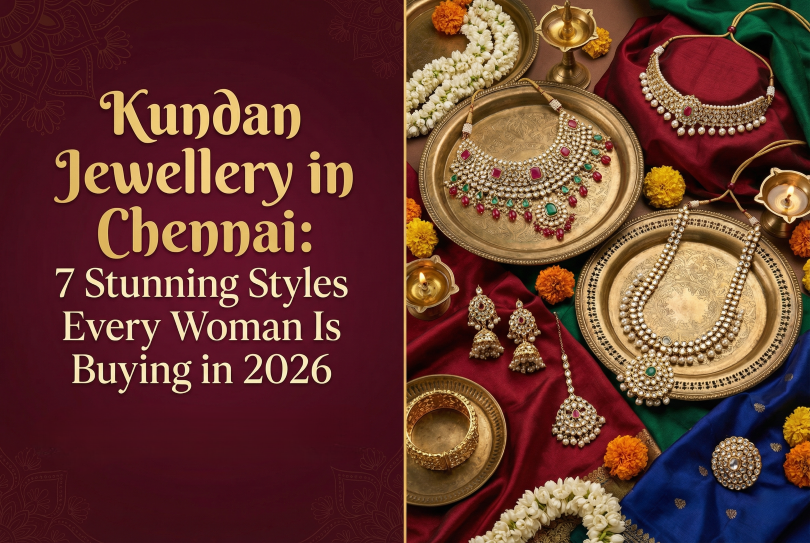
Quick Answer: Kundan jewellery is one of India’s oldest and most celebrated jewellery styles. It uses highly refined gold foil to set uncut gemstones without claws or prongs. In 2026, Chennai women are buying Kundan for everything — from grand weddings to casual festive wear. This guide covers the 7 most popular Kundan styles right now, how to wear each one, how to spot real Kundan from fake, and where to find the best pieces in Chennai.
Contents
- 1 What Is Kundan Jewellery?
- 2 The History Behind Kundan — From Royal Courts to Chennai Homes
- 3 How Kundan Jewellery Is Made (Step by Step)
- 4 Kundan vs Polki vs Meenakari — What Is the Difference?
- 5 7 Kundan Styles Chennai Women Are Buying in 2026
- 6 How to Style Kundan Jewellery for Every Occasion
- 7 Kundan Jewellery for South Indian Brides — A Special Guide
- 8 How to Spot Real Kundan from Fake
- 9 How to Care for Your Kundan Jewellery in Chennai’s Climate
- 10 Where to Buy Kundan Jewellery in Chennai
- 11 Summary: What to Remember About Kundan Jewellery
- 12 Frequently Asked Questions (FAQs)
- 12.1 What is Kundan jewellery?
- 12.2 Is Kundan jewellery real gold?
- 12.3 What is the difference between Kundan and Polki jewellery?
- 12.4 Is Kundan jewellery good for daily wear?
- 12.5 How do I clean Kundan jewellery at home?
- 12.6 Can Kundan jewellery be repaired if a stone falls out?
- 12.7 What outfits go best with Kundan jewellery?
- 12.8 Which is the best place to buy Kundan jewellery in Jaipur?
- 12.9 What is the price range for Kundan jewellery in Chennai?
- 12.10 Can Kundan jewellery be worn by South Indian brides?
- 12.11 How long does Kundan jewellery last?
What Is Kundan Jewellery?
Kundan jewellery is a traditional Indian jewellery style where gemstones are set into a gold framework using thin sheets of pure gold foil. No prongs. No claws. No mechanical grips.
The word Kundan comes from the Sanskrit word Kundana, which means pure gold. That name tells you exactly what makes this jewellery different. The gold used in the setting process is refined to its purest form — typically 24-karat — until it becomes soft enough to press around a stone and hold it firmly in place.
The result is a piece of jewellery that looks like the stone and the gold have fused together. The surface catches light evenly. The stones glow from within. And no metal edge interrupts the view of the gemstone.
This is why Kundan jewellery looks the way it does — rich, layered, almost liquid in its finish. It is not mass-produced. Each piece is handmade by craftspeople who have spent years learning the technique.
Today, Kundan jewellery is available at different price points. High-end pieces use real diamonds, emeralds, rubies, and sapphires. Mid-range pieces use semi-precious stones. Affordable fashion Kundan uses glass stones and brass or copper bases with gold plating. All three categories follow the same basic setting technique.
The History Behind Kundan — From Royal Courts to Chennai Homes
Kundan jewellery is not a recent trend. Its roots go back well over 2,500 years.
The earliest evidence of this jewellery-making technique comes from the Indus Valley civilisation, where artisans in Rajasthan and Gujarat were already setting stones into gold frameworks. But the style reached its peak during the Mughal era, between 1526 and 1857.
During this period, Mughal emperors and their courts became obsessed with fine jewellery. Skilled craftspeople — called Kundansaz — were brought to royal courts to create elaborate pieces for emperors, queens, and nobility. A single necklace could take months to complete. The stones used were real — diamonds, rubies, emeralds, and sapphires from across the world.
Kundan jewellery became a symbol of power. Queens wore it to show wealth. It was gifted at royal marriages. It was used to seal political alliances. Whoever wore Kundan wore history.
After the Mughal era ended, the craft spread from the royal courts into the hands of skilled artisans across Rajasthan, Gujarat, Delhi, and eventually the rest of India. Jaipur became — and still remains — the heart of Kundan jewellery-making in India. The city’s artisans carry on centuries-old techniques that have been passed from father to son for generations.
Today, Kundan jewellery has found a new home across India — including Chennai. South Indian women, who have always had a deep connection with fine jewellery and traditional craftsmanship, have embraced Kundan with enthusiasm. The style sits beautifully alongside South Indian classics like temple jewellery and Kemp sets, and it has found its place in bridal trousseaux across Tamil Nadu.
How Kundan Jewellery Is Made (Step by Step)
Understanding how Kundan jewellery is made helps you appreciate why it costs what it costs — and why no two pieces are ever exactly alike.
The process is entirely handmade. It involves multiple artisans, each specialising in one part of the process. A single piece can take anywhere from two weeks to four months to complete, depending on the complexity of the design.
Step 1: Ghaat — Building the Framework
The first step is building the skeleton of the jewellery piece. The craftsman takes thin strips of 22-karat gold and shapes them into the outline of the design. This framework must be precise because everything else is built on top of it.
Step 2: Paadh — Filling with Lac
Once the framework is ready, the inside is filled with lac — a natural wax-like resin. Lac gives the piece its body and strength. Without it, the delicate gold frame would bend and collapse under the weight of the stones.
Step 3: Khudai — Engraving the Surface
In this step, the outer surface of the gold framework is engraved with patterns and designs. These could be floral motifs, geometric patterns, or architectural shapes. Lotus flowers, tulips, carnations, peacocks, and fish are among the most common motifs in traditional Kundan jewellery.
Step 4: Meenakari — Adding Enamel
This step happens on the reverse side of the piece. Meenakari is the art of adding colourful enamel to the back of the jewellery. If you flip a real Kundan piece over, you will see brilliant colours — blues, greens, reds — painted in intricate patterns. Many buyers never see this hidden artwork, but it is a mark of craftsmanship and authenticity.
Step 5: Pakai — Setting the Stones
This is the most critical step. The Kundansaz places the gemstones one by one into the engraved cavities in the gold framework. A thin sheet of gold foil is placed between the stone and the base. The foil acts like a mirror, reflecting light back through the stone and making it appear more brilliant. The gold is then gently pressed around the edges of the stone, holding it in place without any prong or mechanical grip.
Step 6: Chillai — Finishing and Polishing
The final step is polishing. The piece is cleaned and finished by hand, and the stones are checked to make sure each one is set securely and evenly.
This process — six steps, multiple artisans, weeks or months of work — is why authentic Kundan jewellery carries the price it does. You are not just buying a piece of jewellery. You are buying hours of skilled labour and centuries of tradition.
Kundan vs Polki vs Meenakari — What Is the Difference?
Many women in Chennai confuse Kundan with Polki and Meenakari. They are related but different.
Kundan vs Polki
Kundan and Polki look very similar. Both use the same gold foil setting technique. The difference is in the stones.
Kundan jewellery uses glass stones or treated gemstones that are cut and polished. The stones have a smooth, shiny surface and catch light evenly.
Polki jewellery uses uncut natural diamonds — called Polki diamonds — that are set in their raw form. Polki diamonds have a rough, uneven surface that gives the jewellery a matte, natural sparkle. Because it uses real, uncut diamonds, Polki jewellery is significantly more expensive than Kundan.
If you see a piece and the stones look rough and natural, it is likely Polki. If the stones look smooth and evenly reflective, it is likely Kundan.
Kundan vs Meenakari
Meenakari is not a jewellery type — it is a technique. It refers to the art of enamelling the surface of metal with colourful patterns. Meenakari is often combined with Kundan jewellery. In fact, most authentic Kundan pieces have Meenakari work on the back. When you see a piece described as Kundan Meenakari, it means the front has Kundan stone settings and the back has colourful enamel work.
You can also find Meenakari jewellery without Kundan settings — pieces where the entire surface is covered in enamel art with minimal stone work.
A Simple Way to Remember
Think of it this way. Kundan is the setting technique using pure gold foil. Polki is the type of stone — uncut diamonds. Meenakari is the enamel work on the reverse. A single piece of jewellery can be all three at once.
7 Kundan Styles Chennai Women Are Buying in 2026
This is where things get specific. Not all Kundan jewellery is the same. Different styles suit different occasions, outfits, and budgets. Here are the 7 styles that are moving fastest in Chennai right now.
Style 1: Pachi Kundan Sets
Pachi Kundan is the lightest and most wearable version of traditional Kundan jewellery. The word Pachi means flat in some regional languages, which describes how the stones are set — close to the surface, flat against the gold, without the raised profiles of heavy traditional pieces.
Pachi Kundan sets are perfect for Chennai because they are lighter in weight. They do not feel heavy on the neck or ears during long wedding functions. They also tend to be more affordable than heavy traditional Kundan sets.
In 2026, Pachi Kundan is especially popular for pre-wedding events like mehendi and engagement functions, as well as destination weddings where brides want to look traditional without feeling weighed down.
A standard Pachi Kundan set includes a choker or mid-length necklace, jhumka earrings, and a maang tikka.
Style 2: Kundan Choker Sets
The choker is having a major moment in 2026, and Kundan chokers are at the centre of it. A Kundan choker sits high on the neck — usually two to four centimetres wide — and frames the face beautifully.
Kundan chokers work with almost every neckline. Deep V-necks, square necks, boat necks — a well-fitted choker works with all of them. For Chennai women who wear silk sarees with boat-neck blouses, a Kundan choker is a natural pairing.
The minimalist trend has influenced Kundan chokers in 2026. New designs feature cleaner layouts with fewer stones and more visible gold. This means the choker looks elegant without being heavy or overwhelming.
Pair a Kundan choker with simple gold jhumkas or drop earrings, and you have a complete, balanced look without needing any additional jewellery.
Style 3: Layered Kundan Rani Haar
A Rani Haar is a long necklace — traditionally worn by queens — that falls below the chest. A Kundan Rani Haar is one of the most dramatic and beautiful pieces in Indian bridal jewellery.
For grand weddings and reception events in Chennai, the layered Rani Haar remains a top choice. The new versions in 2026 use lighter metals and fewer stones per layer, making the piece feel grand without being uncomfortable.
Layered Rani Haars work best with heavily embroidered silk sarees and lehengas. They fill the space of a low-cut or deep-back blouse beautifully. For Kanjivaram saree brides, a Kundan Rani Haar in green or red stones adds richness that complements the silk’s sheen.
One styling tip: if your outfit is heavily embroidered, choose a Rani Haar with a simple design. If your outfit is plainer, go for a Rani Haar with complex stone detailing. Let one element lead.
Style 4: Antique Kundan with Meenakari Back
Antique Kundan is one of the fastest-growing sub-trends in Chennai’s jewellery market in 2026. Instead of the traditional bright gold finish, antique Kundan uses an oxidised or muted gold tone that looks aged and heritage-inspired.
The appeal is obvious. Antique Kundan pairs better with natural fabrics — khadi, linen, organic cotton sarees — and with earthy outfit colours like rust, olive, mustard, and terracotta. For women who want Kundan for casual or semi-formal events, antique finishes are more versatile than shiny traditional gold.
Many antique Kundan pieces also feature elaborate Meenakari on the back — bright blues and greens against the oxidised gold — which makes them conversation pieces when the reverse is visible.
This style is particularly popular among younger Chennai women in their 20s and 30s who want traditional jewellery but with a more relaxed, everyday aesthetic.
Style 5: Pastel Stone Kundan
Traditional Kundan jewellery uses bold stone colours — deep red, rich green, royal blue. But in 2026, a softer palette has entered the scene and it is proving very popular.
Pastel Kundan features stones in blush pink, soft mint, ivory, peach, and pale lavender. These colours work beautifully with the pastel and dusty-tone lehengas and sarees that have dominated Indian bridal fashion in the past two years.
For Chennai brides who are choosing lighter coloured silk sarees — ivory, gold, blush — instead of traditional deep red, pastel Kundan sets are the perfect match. They add colour and richness without clashing with a lighter outfit palette.
Pastel Kundan is also more versatile for post-wedding wear. A pastel choker or pair of earrings can be worn with regular ethnic outfits long after the wedding season ends.
Style 6: Lightweight Kundan Earrings for Daily Wear
Not all Kundan has to be worn for weddings. This is a big shift happening in 2026 — Kundan earrings are moving into everyday wear.
The reason is the rise of lightweight Kundan designs. Small Kundan stud earrings, minimal Kundan drops, and compact Kundan jhumkas are now available in designs light enough to wear to the office, to college, or to a casual outing.
For Chennai women who wear salwar kameez or cotton sarees to work, a pair of small Kundan earrings adds elegance without effort. The gold tone of Kundan also pairs naturally with the gold jewellery most South Indian women already wear daily.
When buying Kundan earrings for daily wear, look for pieces with secure backs, smooth edges that will not catch on clothing or hair, and stones set firmly without any wobble.
Style 7: Kundan Maang Tikka and Hair Accessories
The maang tikka — the ornament worn at the parting of the hair — is a staple of Indian bridal jewellery. In 2026, Kundan maang tikkas are evolving beyond the traditional round pendant design.
New Kundan tikkas feature elongated pendants, asymmetric shapes, floral clusters, and even chain-link designs that drape across the hair. Some brides are replacing the tikka with a Kundan mathapatti — a broader ornament that covers more of the forehead.
For Chennai brides, the Kundan maang tikka adds a North Indian elegance to traditional South Indian bridal looks. Paired with a Kanjivaram silk saree and a set of temple jewellery, a single Kundan tikka creates an interesting blend of regional traditions that looks rich and personal.
Hair accessories beyond the tikka are also trending — Kundan hair pins, juda pins, and passa (side ornaments) are being incorporated into bridal hairstyles for a layered, complete look.
How to Style Kundan Jewellery for Every Occasion
Knowing which Kundan style to choose is only half the work. Knowing how to wear it is just as important.
For Weddings
Weddings call for your most complete look. A full Kundan set — necklace, earrings, maang tikka, and bangles — is appropriate for a bride or a close family member.
The key rule is outfit coordination. If your outfit is heavily embroidered, choose a Kundan set with a simpler design so the two do not compete. If your outfit is plainer — like a silk saree without much zari work — choose a Kundan set with elaborate detailing to fill the visual space.
Match stone colours to your outfit. A deep green outfit pairs well with Kundan set in red or gold-toned stones. A red lehenga pairs beautifully with Kundan set in green or white stones.
Festive events allow for more vibrant styling. Choose Kundan pieces with colourful stones — green, blue, or purple — that reflect the spirit of the celebration.
For Pongal and traditional Tamil festivals, Kundan pairs beautifully with Kanjivaram sarees. Choose a Kundan choker or short necklace so the focus stays on the saree’s pallu while the jewellery frames your face elegantly.
For Receptions and Cocktail Events
Receptions have a more modern, fashion-forward energy. This is where Kundan meets fusion styling.
Pair a Kundan choker with a draped gown or a contemporary blouse with jeans. Wear oversized Kundan earrings with a sleek silk saree and minimal other jewellery. Let one bold Kundan piece anchor the look.
For high-neck or heavily detailed blouses, skip the necklace entirely and focus on Kundan statement earrings instead.
For Everyday Ethnic Wear
Keep it simple. A small Kundan pendant or a pair of lightweight Kundan earrings with a regular cotton saree or kurta is all you need. Choose pieces with softer stone colours and minimal detailing for an understated, put-together look.
Kundan Jewellery for South Indian Brides — A Special Guide
Most Kundan jewellery content is written with North Indian brides in mind. But South Indian brides — and especially Chennai brides — have their own jewellery traditions, and Kundan fits into them in specific ways.
Where Kundan Fits in a South Indian Bridal Trousseau
A typical Chennai bride’s jewellery set includes temple jewellery, Kemp sets, gold chains, and traditional gold bangles. Kundan has entered this space as a complementary style — not a replacement for traditional South Indian pieces but an addition that adds variety and a different visual energy.
Many Chennai brides now choose Kundan for their engagement or mehendi function and reserve their temple jewellery or gold sets for the wedding day itself. This gives them two distinct, complete looks across the wedding events.
Which Kundan Styles Work Best with South Indian Outfits
Kanjivaram silk sarees work best with traditional Kundan designs in rich stone colours — red, green, and ivory. The gold-heavy nature of Kanjivaram sarees means the Kundan set needs to be substantial. A lightweight or minimalist Kundan piece may look underpowered against a heavy silk saree.
Pattu half-sarees (pavadai davani) worn for engagement functions pair beautifully with Pachi Kundan sets. The lighter weight is appropriate for a younger look, and the pastel stone options complement the bright colours common in half-sarees.
Cotton sarees for casual temple events can be paired with a single Kundan pendant or small Kundan jhumkas. Keep the rest of the jewellery simple — one gold chain, small bangles — and let the Kundan piece provide the focal point.
Combining Kundan with Temple Jewellery
Mixing Kundan and temple jewellery in one look is possible, but it requires care. The two styles have different visual languages. Temple jewellery is structured around religious motifs — deities, lotus, peacocks — while Kundan is about stone setting and gold artistry.
The safest combination is to use one style for the upper body (necklace area) and the other for the lower body or accessories. For example, wear a temple jewellery necklace with Kundan earrings. Or wear a Kundan necklace with temple jewellery bangles. Mixing both at the same level — a temple jewellery necklace with Kundan necklace — creates visual competition.
How to Spot Real Kundan from Fake
The market for Kundan jewellery is large, and not all of it is made with the same quality. Here is how to tell a well-made piece from a poorly made one.
Check the Reverse Side
Real Kundan jewellery — or quality Kundan fashion jewellery — will have a finished reverse side. Look for Meenakari work or at least a smooth, clean back. A rough, unfinished back with sharp edges is a sign of poor craftsmanship.
Check the Stone Setting
Hold the piece up and look at the stones closely. Each stone should sit flat and even in its setting. The gold foil pressed around the edge of each stone should be smooth and consistent. If stones are uneven, tilted, or if the gold foil looks torn or messy, the craftsmanship is poor.
Check the Weight
Real Kundan jewellery using lac filling has a specific weight to it — not too heavy, not too light. Pieces that feel hollow or extremely light are likely to be made with cheaper base materials without proper lac filling.
Check the Stones for Consistency
In good Kundan jewellery, stones of the same type should match in colour and size across the piece. Random variations in stone colour within the same piece suggest inconsistent or recycled materials.
Ask About the Base Metal
Fashion Kundan jewellery uses brass or copper alloy bases with gold plating. This is normal and acceptable for non-precious jewellery. What matters is the quality of the plating — ask if it is gold-filled or simply gold-toned. Gold-filled pieces last significantly longer.
How to Care for Your Kundan Jewellery in Chennai’s Climate
Chennai’s heat and humidity are hard on Kundan jewellery. The gold foil, lac filling, and stone settings all react to moisture and sweat. Follow these care steps to keep your Kundan pieces looking good for years.
Wipe After Every Wear
After wearing Kundan jewellery, wipe it gently with a dry, soft cloth. Do not use a wet cloth. This removes sweat, oils, and surface dust before they can settle into the stone settings or affect the gold foil.
Store in Separate Soft Pouches
Never store Kundan jewellery loose in a box with other pieces. The stones can scratch against each other and against other metals. Store each Kundan piece in its own soft cloth pouch. Keep pouches in a cool, dry place — not in bathrooms or near windows.
Keep Away from Water
Do not wear Kundan jewellery while bathing, swimming, or cooking. Water — especially hot water and steam — can weaken the lac filling over time. It can also loosen stone settings.
Avoid Perfume Direct Contact
Always apply perfume and hairspray before wearing your Kundan jewellery — never after. Alcohol in these products dulls the gold foil and can affect the stone surface over time.
Never Use Ultrasonic Cleaners
Ultrasonic cleaners use vibration to clean jewellery. This is dangerous for Kundan pieces because the vibration can loosen stones from their settings. Have Kundan jewellery cleaned professionally by someone who specialises in traditional Indian jewellery.
Handle the Meenakari Side with Care
The enamel work on the back of Kundan jewellery is fragile. Enamel can chip if the piece is dropped or knocked against hard surfaces. Hold Kundan pieces from the frame, not the back, when handling them.
Where to Buy Kundan Jewellery in Chennai
Chennai has a growing number of places to find quality Kundan jewellery — both in person and online.
T. Nagar remains Chennai’s jewellery hub. Several jewellers in the Pondy Bazaar and Usman Road area carry Kundan pieces alongside their gold jewellery collections. When shopping in person, always ask to see the reverse side of the piece and check the stone setting quality before buying.
Online via Plushh Chennai — plushhchennai.com offers a curated range of fashion Kundan jewellery designed for the modern Chennai woman. Each piece is chosen for wearability, quality of stone setting, and finish. Shipping is available across India.
For reference on authentic Kundan and the craft behind it, the Crafts Council of India (craftscouncilofindia.org) and the National Crafts Museum in Delhi are excellent resources for understanding what genuine handmade Kundan looks and feels like.
For gemstone and jewellery quality standards in India, refer to the Bureau of Indian Standards (bis.gov.in) which sets hallmarking guidelines for precious metal jewellery.
Summary: What to Remember About Kundan Jewellery
Kundan jewellery has survived for over 2,500 years because it is genuinely beautiful and genuinely skilled work. It is not a passing trend. It is a craft tradition that has evolved with every generation — from Mughal courts to modern Chennai homes.
The 7 styles most in demand right now — Pachi Kundan, chokers, Rani Haar, antique Meenakari, pastel stones, lightweight earrings, and maang tikkas — give you a full range from grand bridal wear to everyday elegance.
For South Indian women in Chennai, Kundan offers something unique: a way to wear traditional Indian jewellery that carries centuries of craftsmanship while fitting naturally into modern bridal looks and festive dressing.
If you are new to Kundan, start with a pair of Kundan earrings or a simple choker. Wear it with a silk saree or a cotton kurta. You will understand quickly why this jewellery style has never gone out of fashion — and never will.
Frequently Asked Questions (FAQs)
What is Kundan jewellery?
Kundan jewellery is a traditional Indian jewellery style where uncut or polished gemstones are set into a framework of pure gold foil. The word Kundan means pure gold in Sanskrit. The technique originated in Rajasthan during the Mughal era and is still made entirely by hand today.
Is Kundan jewellery real gold?
Traditional Kundan jewellery uses 24-karat refined gold for the foil setting and 22-karat gold for the framework. Fashion Kundan jewellery — the more affordable variety — uses brass or copper bases with gold plating instead of real gold. Always ask about the base metal before buying.
What is the difference between Kundan and Polki jewellery?
Both Kundan and Polki use the same gold foil setting technique. The difference is the stone. Kundan uses glass stones or polished gemstones. Polki uses uncut natural diamonds. Polki is significantly more expensive because of the real diamonds. If the stones look rough and natural, it is Polki. If the stones are smooth and shiny, it is Kundan.
Is Kundan jewellery good for daily wear?
Heavy traditional Kundan sets are best reserved for special occasions. However, lightweight Kundan earrings and simple Kundan pendants are perfectly suitable for daily wear. Look for pieces with secure stone settings, smooth edges, and lightweight bases for everyday use.
How do I clean Kundan jewellery at home?
Wipe with a dry, soft cloth after every wear. Do not use water, liquid cleaners, or ultrasonic cleaners. If dust has settled into the stone settings, use a very soft, dry brush — like a clean makeup brush — to gently remove it. For deeper cleaning, take the piece to a jeweller who specialises in traditional Indian jewellery.
Can Kundan jewellery be repaired if a stone falls out?
Yes. Kundan jewellery can be repaired by a skilled Kundansaz. Since the stones are held by gold foil without prongs, a trained craftsman can press new foil around a replacement stone and restore the piece. Not all jewellers have this skill — look for someone who specifically works with traditional Indian jewellery or Jadau work.
What outfits go best with Kundan jewellery?
Kundan jewellery pairs beautifully with silk sarees, lehengas, heavily embroidered anarkalis, and traditional bridal outfits. In 2026, it is also being worn with fusion outfits — draped gowns, indo-western blouses, and even simple cotton sarees for everyday wear. The key is proportion — match the weight of the jewellery to the weight of the outfit.
Which is the best place to buy Kundan jewellery in Jaipur?
Jaipur remains the heart of authentic Kundan jewellery in India. The Johari Bazaar area in Jaipur has the highest concentration of Kundan jewellery workshops and retail stores. When visiting, ask to see the artisans at work and inspect the reverse side of pieces for Meenakari work, which is a sign of authentic craftsmanship.
What is the price range for Kundan jewellery in Chennai?
Prices vary widely based on materials. Fashion Kundan jewellery with brass base and glass stones starts from around ₹500 for earrings and ₹1,500 to ₹5,000 for necklace sets. Semi-precious stone Kundan ranges from ₹5,000 to ₹25,000 per set. Authentic Kundan with real gold and precious stones can range from ₹50,000 to several lakhs depending on the stones used.
Can Kundan jewellery be worn by South Indian brides?
Absolutely. Many Chennai and South Indian brides are incorporating Kundan into their bridal look — especially for pre-wedding events like engagement and mehendi. Kundan pairs well with Kanjivaram silk sarees and can complement temple jewellery when chosen carefully. The key is to use Kundan as an accent, not a replacement for traditional South Indian bridal pieces.
How long does Kundan jewellery last?
With proper care, quality Kundan jewellery lasts decades. Authentic Kundan with real gold lasts generations — many families pass it down as heirlooms. Fashion Kundan with gold plating typically lasts two to five years with good care before the plating begins to fade, especially in humid climates like Chennai.
Written by the jewellery team at Plushh Chennai — your go-to destination for trending fashion jewellery in Chennai. Browse our full Kundan collection at plushhchennai.com/shop-now. For more jewellery guides, visit our blog.
For more on Indian jewellery crafts and cultural heritage, explore resources from the Crafts Council of India and the National Institute of Fashion Technology.